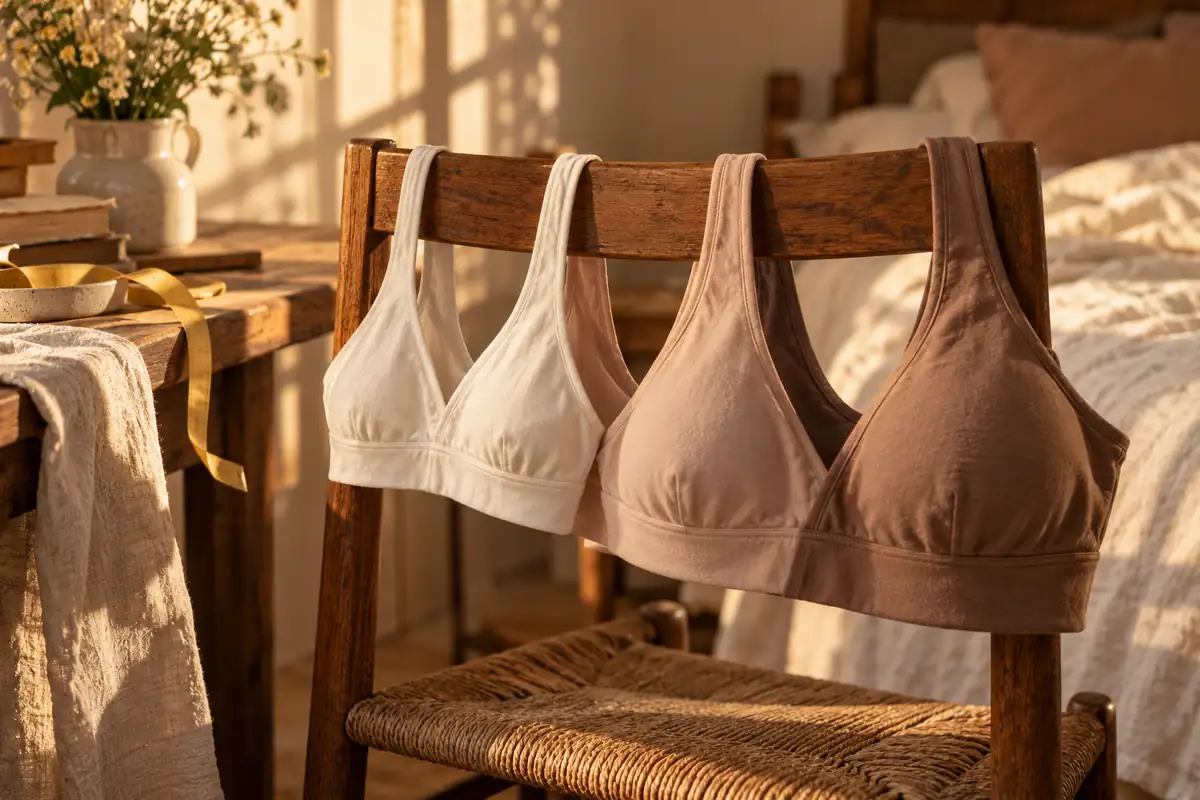
Bralettes are wire-free, lightly lined or unlined, and usually sold in S, M, L and XL. That makes them easy to buy, and easy to get wrong if your band and cup don’t fit the chart’s assumptions.
Typical bralette size chart
| Bralette size | Usual bra band | Example bra sizes |
|---|---|---|
| S | 32–34 | 32A, 32B, 34A |
| M | 34–36 | 34B, 34C, 36A |
| L | 36–38 | 36B, 36C, 38A |
| XL | 38–40 | 38B, 38C, 40A |
Most standard ranges stop at a C or D cup. This is a common pattern, not a standard. Brands differ by about a size, and their cup range varies, so always check the chart for the exact product. If you don’t know your band, measure snugly under the bust: the bra size calculator gives you band and cup in a minute.
Why S, M, L works for some and not others
Alpha sizes assume a small band goes with a small cup and a large band with a large cup. That works for many people, and fails for two common shapes:
- Small band, full bust (30E, 32F, 32G). An S or M fits the band, but the cups are too small. Sizing up to an L fits the cups but leaves the band loose. Choose a cup-sized bralette, sold in sizes like 32F.
- Large band, small bust (40A, 42B). An XL fits the band, but the cups gape. Look for a style with a shallow or adjustable cup.
Some ranges use “busty” or “curvy” alpha sizes that pair a small band with bigger cups. These are worth a look if a standard chart puts you in the wrong place.
Plus-size and large-bust bralettes
Wire-free does not have to mean unsupported, but stretch lace alone won’t hold a full bust. Look for:
- A wide underband or longline cut that anchors on the ribcage;
- Wide or padded straps, or a racerback, to spread the weight;
- Seamed, double-lined or mesh-lined cups, or an inner sling for shape and separation;
- Back hooks with several rows, so you can tighten the band as it stretches.
Bralette fit problems and fixes
- The band rolls or rides up: too loose. Go down a size, not up.
- Spill or one shape across the front (“uniboob”): stretch cups can’t hold the volume. Try seamed cups or band-and-cup sizing.
- Straps dig in: the band isn’t carrying the weight. Choose a firmer band and wider straps.
- Cups gape: too big, or the cut is wrong for your shape. Size down or try a lower, demi cut.
The band test from the fit check applies to bralettes too: level all the way round, with two fingers’ room at the back.
Bralettes as gifts
Because S, M and L cover a range, a bralette is one of the safest lingerie gifts when you don’t know her exact size. The gift guide explains how to choose.
Sources & method: sizing rules follow the standard band-and-cup system used by UK, US, AU and EU brands, checked against fitting guides from specialist retailers and fitting communities. How we work.