Bra size explained in one sentence
Every bra size is two facts written together: how big the frame is, and how much the bust stands out from it. The number is the frame. The letter is the difference. Everything else on this page is detail on those two facts, or on how each country writes them.
The band size: the number
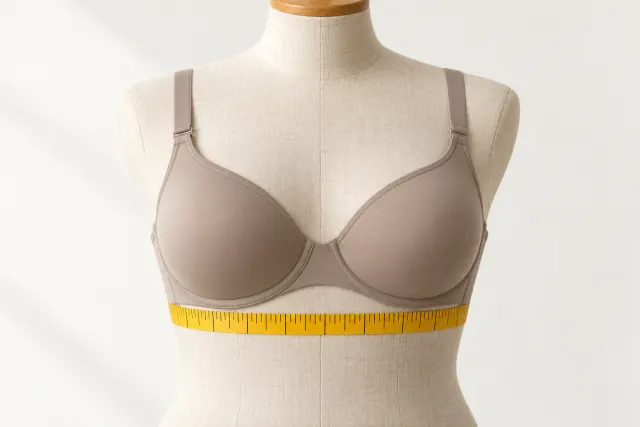
The band is the part that goes around your ribcage, and it does most of the supporting work. Its number comes from one measurement: snug around the ribcage, directly under the bust, with the tape level.
- In US and UK sizing, the band is that measurement in inches, rounded to the nearest inch.
- Bands are sold in even numbers: 28, 30, 32, 34 and so on. If you measure an odd number, the band below is the usual starting point and the band above is a fair second choice.
- There is no +4. An older method added 4 inches to the underbust, which tends to give loose bands and small cups.
The exact steps, including where to hold the tape and how to handle an odd number, are in how to measure bra size. This page only needs the result.
The cup size: a difference, not a volume
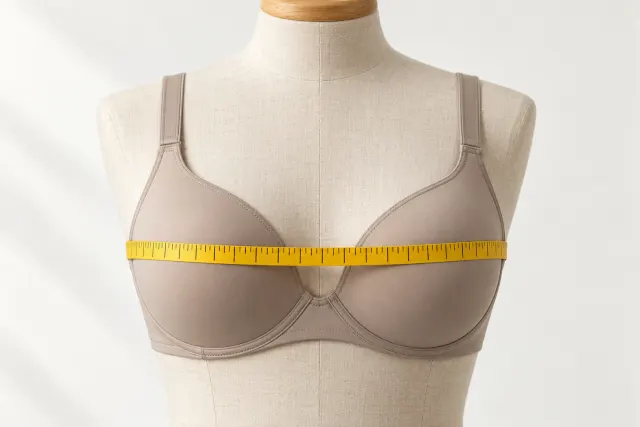
The cup letter comes from a second measurement, around the fullest part of the bust. Subtract the band and count the inches. Each inch is one step along the letters: 1 inch is A, 2 is B, 3 is C, 4 is D, 5 is DD.
That makes a cup letter relative. It tells you the shape of the size, not the amount. A C cup on a 30 band and a C cup on a 40 band both have 3 inches of difference, but the 40C holds much more, because it is cut for a bigger frame. A letter on its own means very little. The bra cup size guide goes through every letter and the common myths about them.
Sister sizes: why one bra fits like another
Because cups are relative to the band, you can trade one for the other. Go down one band and up one cup, and the cup volume stays about the same. Go up one band and down one cup, and the same thing happens.
So 30DD, 32D, 34C, 36B and 38A all hold roughly the same cup volume. What changes is the band length, and with it the support. That is why a sister size is a fix for a band that feels wrong, not a shortcut for a size that is out of stock and never tried on. The sister sizes tool lists them for any size.
Countries: same body, different labels
Five sizing systems cover most of the bras you can buy. They measure the same thing and write it differently.
- Bands. US and UK use inches. Australia subtracts 22, so a 34 is a 12. Europe uses its own centimeter-based steps of 5, so a 34 is a 75. France adds 15 to the EU number, so a 34 is a 90.
- Cups. All systems agree up to D. After that the UK uses double letters (DD, E, F, FF, G), the US often uses DD, DDD and then G, H, I, and Europe and France use single letters in order (E, F, G, H).
The bra size conversion page translates any size between systems.
Why the same letter means different things
Put the systems side by side and the same letter lands on different steps. A G cup is the clearest case:
| Cup letter G | Inches of difference |
|---|---|
| US G | 7 |
| EU / FR G | 7 |
| UK / AU G | 9 |
So a UK G is two full cup sizes larger than a US G. Ordering by letter across countries is the most common way to get a cup that is badly off. Convert first, then shop.
Worked example: from tape measure to five labels
Here is the whole process for two sets of measurements, using the same logic as our calculator.
| Step | Example 1 | Example 2 |
|---|---|---|
| Snug underbust | 32 in (81 cm) | 34 in (86 cm) |
| Fullest bust | 37 in (94 cm) | 41 in (104 cm) |
| Band | 32 | 34 |
| Difference | 5 in | 7 in |
| Cup step | 5th step | 7th step |
| US | 32DD | 34G |
| UK | 32DD | 34F |
| AU | 10DD | 12F |
| EU | 70E | 75G |
| FR | 85E | 90G |
Each column is one bra size, written five ways. Example 2 shows the split clearly: the US and EU both say G, while the UK and Australia say F for the same cup.
The 3 rules that explain every bra size
Every size on every chart follows from three rules.
- The band is your snug underbust. Rounded to an even number, with no inches added. It sets the frame and does most of the support.
- Each inch of difference is one cup step. The letter is a count of inches between bust and band, so it only means something next to its band.
- One band down and one cup up holds the same volume. That is the sister-size rule, and it explains why a 32D and a 34C can feel so alike in the cup.
Country systems add a fourth layer of naming on top, but they never change these three rules. Once you know them, any label can be read.
From explanation to your own size
Knowing how sizes work is the first half. The second half is your numbers. Measure the two places, enter them in the calculator, and it returns the band and cup in all five systems. Then check the first bra you try against the four points in how a bra should fit. The label is where you start, and the fit is the final answer.
Sources & method: sizing rules follow the standard band-and-cup system used by UK, US, AU and EU brands, checked against fitting guides from specialist retailers and fitting communities. How we work.