Uneven breasts are common
Very few people have two identical breasts. One is often slightly fuller, sits a little higher, or has a different shape. For many the difference is too small to notice in a bra. For others it is clear enough that one cup fits and the other gapes or spills.
Either way, it is a fit question, not a problem with your body. Bras are made symmetrical, and people are not. The fixes below close that gap.
The rule: fit the larger side
Always choose the size that fits your larger breast. Here is why:
- A cup that is too small causes spill, wire pressure on breast tissue, and a gore that lifts away from the breastbone. You cannot fix that from the outside.
- A cup that is a little too big leaves some empty space. You can fill or tighten that space with simple changes.
When you measure, take the full bust measurement as normal across both breasts. The calculator gives you a starting size, and the how to measure bra size guide shows where to place the tape. Then try bras on and judge the fit by the larger side.
Ways to even out the smaller side
Removable pads
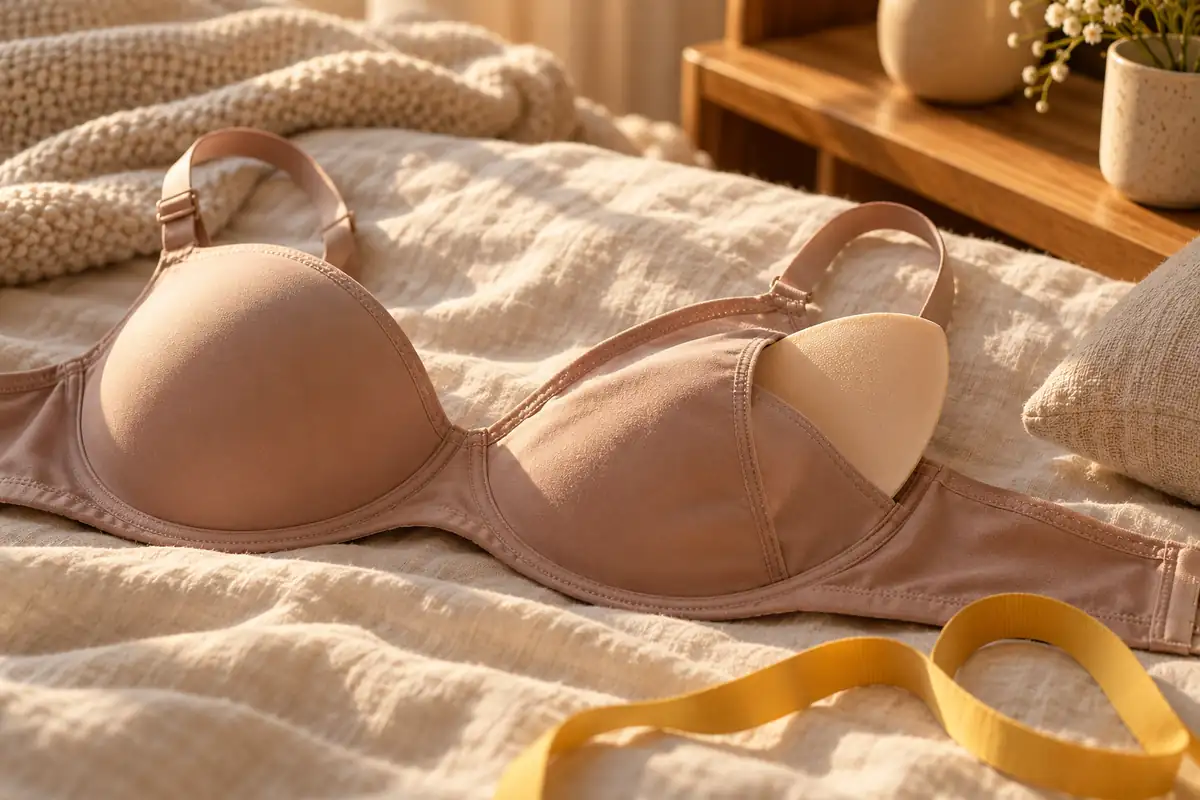
Many padded and t-shirt bras have small pockets inside each cup with a removable pad. Take the pad out of the larger cup and leave it in the smaller one. That alone evens out many small differences. You can also buy separate inserts and add one only to the smaller cup.
Stretch-lace top cups
Some bras have a firm lower cup and a stretchy lace or knit upper edge. The stretchy part lies flat against each breast, whatever its size, so a small difference disappears. This is one of the simplest styles for uneven breasts.
Adjust the straps separately
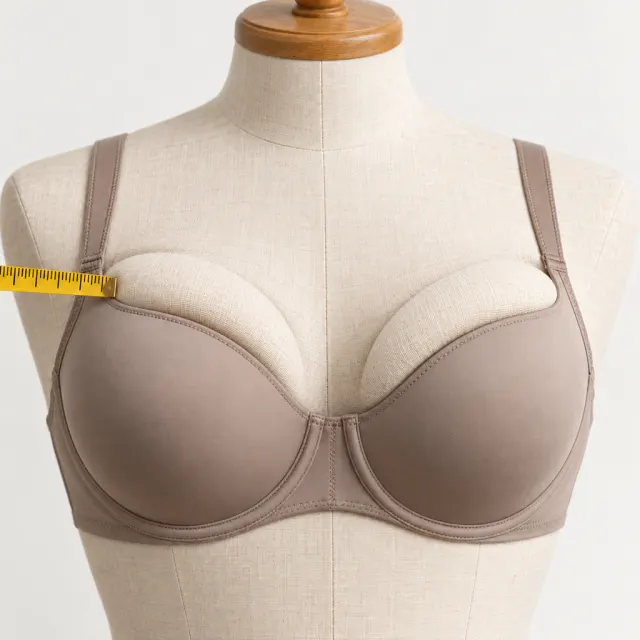
Straps do not need to be the same length. Shorten the strap on the smaller side a little to lift that cup and reduce gaping at the top. Keep checking that you can still slide two fingers under the strap. The band should still do most of the support work.
Choose seamed or soft cups
Rigid molded cups hold a fixed shape, so an emptier cup shows a wrinkle or a dent. Seamed, unlined and soft cups bend to the breast and hide small differences better. The types of bras guide explains lined, unlined and seamed cups.
What to do by size difference
Bra cups step up by about one inch (2.5 cm) of bust per letter. Compare how each side fits in the same bra to estimate your difference.
| Difference | How it usually shows | What to do |
|---|---|---|
| Under one cup | A slight gap or looser top edge on one side | Fit the larger side; shorten the strap on the smaller side; stretch-lace tops hide it well |
| About one cup | One cup fits, the other gapes or wrinkles clearly | Fit the larger side; add a removable pad to the smaller cup; adjust straps separately |
| Two or more cups | One cup spills while the other gapes in every size | Fit the larger side; use a thicker insert or a pocketed bra; soft, seamed or stretch cups; consider a professional fitting |
For larger differences, a fitter can help you find bras with pockets or custom inserts. Some specialist shops and tailors also alter bras, for example by shortening a strap or adding a pocket.
Check the band first
Uneven breasts can hide a band problem. If the band rides up at the back, the cups tilt, and the difference between sides looks worse than it is. Run the 4-point fit check before you change cups. If the band is loose, go one band down and one cup up, which is a sister size with the same cup volume.
Sports bras and bralettes
Compression sports bras flatten both breasts toward the chest, so small differences matter less. Encapsulation sports bras have separate cups, so treat them like any other cup: fit the larger side. Soft bralettes often hide differences well, because the fabric stretches over each breast on its own.
Strapless and molded styles
Strapless bras and molded push-ups are the hardest to adjust, because there are no straps to shorten and the cups are rigid. A removable pad is your main tool here. Try the bra on with the pad in the smaller cup and check the top edge in a fitted top before you buy.
A note on changes
A long-standing difference is ordinary. If a breast changes suddenly in size, shape or feel, see a doctor.
Sources & method: sizing rules follow the standard band-and-cup system used by UK, US, AU and EU brands, checked against fitting guides from specialist retailers and fitting communities. How we work.